

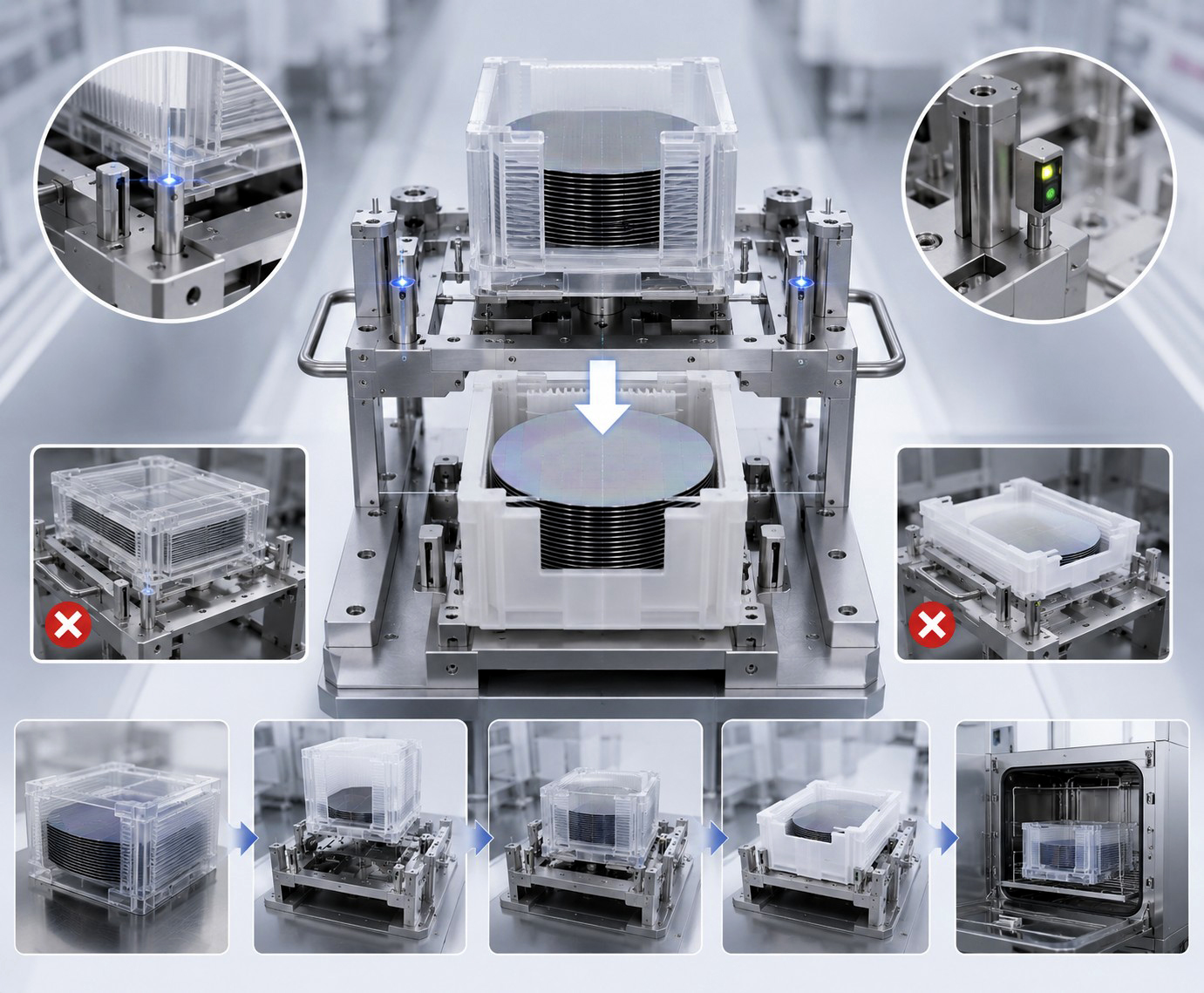
Tray Conversion Fixture Optimization Case Study
Improving Pre-Plasma Cleaning Yield and Operational Efficiency
In semiconductor packaging processes, after Wire Bonding and before Molding, devices must undergo Plasma Cleaning pretreatment within a specified time window to ensure optimal package adhesion quality and process stability. However, traditional operations rely on manual transfer of products from Tray A to a dedicated Plasma Cleaning Tray B. This manual handling process often results in material collisions, scratches, dropped units, and tray misalignment, creating significant bottlenecks that impact yield and production efficiency.
To improve process stability and operational performance, Zhanyang developed a customized Tray Conversion Fixture with poka-yoke (error-proofing) features, successfully enhancing pre-plasma cleaning process quality and operational consistency.
Process Pain Points and Engineering Challenges
In high-precision semiconductor packaging lines, products must undergo tray conversion before Plasma Cleaning. However, traditional manual handling methods often result in material damage such as collisions, scratches, and dropped units due to operator variability. In addition, because Tray A and Tray B have different specifications, any misuse or incorrect placement can directly impact downstream process stability and product yield.
At the same time, semiconductor devices are highly sensitive to electrostatic discharge (ESD), and the tray conversion and plasma cleaning process must be completed within an 8-hour time window. This places stringent requirements on both process timing and operational consistency. Without dedicated fixture support, operations can become inconsistent, workflows may be disrupted, and process variation can increase, making it difficult to achieve the high yield, efficiency, and stability required for volume production.
Solution
To eliminate process risks caused by manual tray conversion, Zhanyang introduced a dedicated Material Box Conversion Fixture. Through a customized fixture design, a stable and standardized material transfer process was established, effectively reducing operator-induced variation and improving overall process consistency.
To address electrostatic concerns, the fixture is fully designed with ESD Protection Features, minimizing the risk of electrostatic damage to sensitive components and ensuring material quality remains stable prior to the Plasma Cleaning process.
In addition, Zhanyang implemented a Precision Positioning Structure featuring slot alignment and dedicated A/B tray matching mechanisms, ensuring accurate tray placement and precise material positioning throughout the transfer process.
To further prevent human errors, a Poka-Yoke Design was incorporated. The fixture prevents operation unless proper positioning is confirmed, effectively eliminating tray misloading and process abnormalities while significantly reducing the risk of operator mistakes.
Process Validation
Following project completion, Zhanyang conducted comprehensive process validation and production-line testing, including:
● Continuous multi-batch operation testing
● Pre-plasma cleaning process integration verification
● Material positioning and transfer stability testing
● ESD protection and operational consistency validation
These evaluations confirmed the fixture's capability to maintain long-term stable operation while meeting semiconductor mass-production requirements.
Test Results
After implementing the Material Box Conversion Fixture and Poka-Yoke mechanism, the customer achieved significant improvements in the pre-plasma cleaning process:
● Complete elimination of material damage incidents
● Zero tray misloading occurrences
● Significantly improved process stability
● Standardized operating procedures
● Substantially reduced operator-induced variation
The solution successfully enhanced both upstream process yield and production-line efficiency.
Customer Benefits
Through this Material Box Conversion Fixture optimization project, the customer gained the following benefits:
Yield Improvement
● Reduced material scratches and damage
● Eliminated tray misloading and operational errors
Productivity Improvement
● Reduced manual handling time
● Established standardized operating procedures
Enhanced Process Stability
● ESD protection design
● Precise positioning and highly consistent operation
Downtime Reduction
● Poka-Yoke mechanism prevents process abnormalities
● Improved long-term equipment operational stability
This solution simultaneously improved yield, productivity, and overall manufacturing competitiveness.
Case Study Summary
This project successfully utilized a Material Box Conversion Fixture and Poka-Yoke Mechanism to eliminate material damage and tray misloading issues caused by manual handling in semiconductor manufacturing processes. The solution significantly improved process stability and operational efficiency prior to Plasma Cleaning.
Leveraging its expertise in customized fixture design, ESD protection technology, and process optimization, Zhanyang continues to help customers enhance semiconductor packaging yields and automation management capabilities, serving as a trusted engineering partner for high-precision semiconductor packaging production lines.


